Today's
EarthStation1.com 15% Off Commemorative Memorial Title: Cinderella
1957 Rodgers & Hammerstein Julie Andrews DVD Download USB
Today, November 18, 2025
November 18: National Princess Day: -- A
day to celebrate the Princess in every girl! Perhaps you know a
Princess who shines because of her gift of laughter, making
everyone around them smile. Maybe your Princess shows her royal
nature by her great acts of kindness and heart of gold. Or your
Princess may be bold and confident, ready to take on every new
challenge Whatever a young lady's gifts, there is a Princess in
each one of them - so let them know and show it! The first
princess to come to the screen was Snow White in 1937's Snow White
and the Seven Dwarfs. Based on the fairy tale by the Brothers
Grimm, this movie was also the first full length traditional
animation film as well as the earliest Disney animated feature
film. When Xena: Warrior Princess came out in 1995 and Mulan was
released in 1998, they showed everyone that a princess can do more
than wear a pretty dress. These two iconic women let children
everywhere know that a princess can also be a strong and
adventurous warrior. New wave princesses like Moana and Frozen's
Elsa show us that you can still be a princess while maintaining
your independence. We all grew up with animated, and live action,
princesses guiding us through life. When thinking of our favorite
princesses, our minds instantly go to Disney. However, when it
comes to National Princess Day, Disney had very little involvement
in its inception. Nest Family Entertainment, a Texas based
entertainment company, teamed up with Rich Animation in 1994 to
create the animated film The Swan Princess, a musical adaptation
of Swan Lake. The studio wanted people of every age to have a day
to celebrate like royalty, embodying the kindness and grace that
we all associated with princess at the time - and thus, National
Princess Day was created. The definition of a princess is
constantly changing. From the 1930s until the 1990s, princesses
were meant to be saved by a prince and live happily ever after.
Nowadays, princesses create their own happily ever after, save the
prince, and then put the prince squarely in the friend zone. So
basically, embodying a princess on National Princess Day is to
embody, what the kids call, the GOAT (Greatest Of All Time). On
Sale @ 15% Off Discount Till Midnight PT!
https://store.earthstation1.com/cinderella-1957-rodgers-amp-hammerstein-julie-andrews-dvd-download1957.html
Today's
EarthStation1.com 15% Off Commemorative Memorial Title: Korean War
Films And Documentaries Collection DVD, MP4 Download, USB
Today, November 18, 2025
November 18: National Adoption Day: --
Events are held all over the country to celebrate this holiday,
during which communities and courts join efforts to find the right
families for children in the foster care system. Let's celebrate
National Adoption Day as thousands of foster children are welcomed
into their forever homes! National Adoption Day is an effort to
focus attention on the more than 125,000 children waiting to be
adopted from foster care in the U.S. A coalition of national
partners - the Dave Thomas Foundation for Adoption, Congressional
Coalition on Adoption Institute, Alliance for Children's Rights
and Children's Action Network - founded National Adoption Day. The
coalition, along with the Freddie Mac Foundation, encouraged seven
cities in 2000 to open their courts on or around the Saturday
before Thanksgiving to finalize and celebrate adoptions from
foster care. Michael Nash, a former presiding judge of Los Angeles
County's Juvenile Court, inspired the first National Adoption Day
with his innovative efforts. Nash opened the court on Saturdays,
engaged the volunteer efforts of court personnel, and finalized
adoptions to reduce the backlog of one of the busiest courts in
the nation. Today policymakers, practitioners and advocates
collaborate to plan these annual, one-day events in 400 U.S.
cities. To date the dreams of 75,000 children in foster care have
come true as part of National Adoption Day events. Approximately 2
million Americans are adopted - with about 150,000 adoptions
happening each year, including about 50,000 through foster-care.
U.S. adoptions may be either domestic or international. Domestic
adoptions can be arranged either through a state agency, an
adoption agency, or independently. On Sale @ 15% Off Discount Till
Midnight PT!
https://store.earthstation1.com/korean-war-films-and-documentaries-dvd.html
Today's
EarthStation1.com 15% Off Commemorative Memorial Title: Dispelling
Witches: What Witchcraft Is + Salem Witch Trials MP4 DVD
Today, November 18, 2025
November 18: International Occult Day: --
Today's a day to revel in the unknown and delve into the depths of
the mysteries that surround us. It aims at looking in the shadows
and at the stars to the unknown mystic world. The word occult has
a Latin origin, where it means "hidden knowledge" or
"the knowledge of the unknown." The term 'occult' now
refers to the practices related to mysticism, spirituality, and
esoteric arts like alchemy, future sight, healing, supernatural
gifts, and many more. Many religions and cultures have some
occultic elements. We are dedicating Occult Day to better
understanding such concepts. Occultism is as old as humans. We do
not know who or what started it. But we do know that the word was
coined somewhere around the 16th century in Europe. The term
'occult' refers to practices outside organized religions that have
roots in magic, the supernatural, mythical beasts, and magical
concoctions. Occult practices also include searching for oneself.
The search for the meaning of life, the profane thoughts and
messages one ought to feel from deep-dwelling to the inner self,
the quest to find spiritual awakening, etc. are all part of occult
practices. One might question the relevance of occultism in modern
times. But occult factions are still active, and there are more
than a million people in the U.S.A. who believe in it. Occultism
is fast gaining momentum, just like in the old days. But it is
different now. Occult practices are not about world domination
through dubious practices. Now it is more about conquering the
inner self and finding the truth beyond human comprehension. Or so
it is in the general case. Western occultism has deep roots in
macrocosm - microcosm concepts. It emphasizes the connection
between human beings and cosmic concepts and structures, both
physical and psychological. Through it, people can gain
enlightenment and powers beyond their natural state. Such
paranormal powers are never proved, but there are always figures
in history who claim to have such powers. The most prominent among
such people are usually the founders of some religion or major
movement. Although prophetic abilities are not a guarantee with
occultism, it claims to have some ways to find meaning in a
meaningless world. It helps practitioners tap into their full
potential, hidden within the soul. Modern occultism is about
empowerment. Modern society considers occultism a pseudoscience.
Occult Day, on the other hand, is devoted to dwelling on the
mystery of what is unknown. It is a day for experimentation and
the discovery of powers that have yet to be sensed and discovered
- a day to try to find the full potential of the soul and nature
around us. On Sale @ 15% Off Discount Till Midnight PT!
https://store.earthstation1.com/dispelling-witches-what-is-amp-isn39t-witchcraft-mp4-video-download-394.html
Today's
EarthStation1.com 15% Off Commemorative Memorial Title: In Search
Of Genghis Khan + 2 Bonus Titles DVD MP4 Download USB Drive
Today, November 18, 2025
November 18, 1247: The Mongols: The
Mongol Empire: Mongol Invasions And Conquests: The Mongol Invasion
Of Europe: Missionaries In Mongolia: The Diplomatic Mission Of
Giovanna da Pian del Carpini: -- After overrunning much of Asia
and creating one of the greatest empires ever to exist, stretching
from China through Russia to the borders of Europe itself, the
Mongols threaten to invade and annihilate Western Europe as
Franciscan priest Giovanni del Carpini, an early associate of
Saint Francis of Assisi, delivers, after a perilous 2 and a half
year journey, a letter from the leader of the Mongols Guyuk Khan
to Pope Innocent IV, ordering the Pope to come to the Khan, along
with all the Christian kings of Europe allied to him, to give
fealty and allegiance to the Khan or "be wiped out".
Pope Innocent IV selected Carpini to be a delegate to the Great
Khan of the Mongol Empire. In April 1245, Carpini left Lyon
accompanied by the Franciscan monk and interpreter Benedykt Polak.
Giovanna da Pian del Carpini, born around the year 1180, was a
provincial of the Franciscan Order at Cologne. He had been one of
the early associates of Francis de Assisi, and since 1222 he had
played a major role in the establishment of the Franciscan order.
Franciscan monks took a vow of strict poverty, and the order also
had an emphasis on evangelism, so enduring the hardships of
traveling to unknown lands to spread Christianity there fitted in
perfectly with their ideals. Carpini and Polak took a northern
route from Lyon, going through Bohemia, Poland and Ukraine. In the
still snowy Ukraine, Carpini became very ill and had to be
transported in a cart. When they reached Kiev, they were advised
to travel with Tartar horses through the lands of the Tartars. In
early February 1246, they finally got to the western frontier of
the Mongol Empire. On the right bank of the frozen River Dnieper
was a Mongol encampment of circa 60,000 men, but no one there was
able to translate the Papal letters to any Mongolian dialect.
Still, they wanted to help the envoys, and provided them horses
and guides. On April 4, the monks stopped to rest at a camp on the
Lower Volga, where they stayed while waiting for the Papal letters
to be translated into Mongol, Russian and Arabic. Despite being on
an arduous journey, they had been fasting for the 40 days of lent,
only eating a thin porridge made from millet and melted snow. At
the camp, they were in very poor condition and almost dead from
starvation. Still, they survived, and they also went through a
Mongolian purification ceremony where they passed between fires.
After four days at camp, they had their translations and could
continue their journey. The monks reached the Mongol capital
Karakorum in July 22, 1246. In Karakorum, a new great Khan named
Guyuk, son of Ogadei, was about to be enthroned. The monks invited
him to become a Christian, and he replied that the Pope and the
princes of Europe would have to visit and swear allegiance to him
first. On November 13, 1246, the monks left Karakorum, carrying
with them a letter from the Great Khan to the Pope. Traveling
through Central Asia during the winter was difficult, and they
didn't reach Kiev until June 1247. On November 18, 1247, Carpini
could finally deliver the letter from the Great Khan to the Pope.
In his letter, the Great Khan explained to the Pope that"_.you
must come yourself at the head of all your kings and prove to Us
your fealty and allegiance, And if you disregard the command of
God and disobey Our instructions. We shall look up on you as Our
enemy. Whoever recognizes and submits to the Son of Gods and Lord
of the World (will be spared. Any who) refuses submission will be
wiped out." On Sale @ 15% Off Discount Till Midnight PT!
https://store.earthstation1.com/in-search-of-genghis-khan-historic-1991-tomb-expedition-dvd-mp19914.html
Today's
EarthStation1.com 15% Off Commemorative Memorial Title: Triumph Of
The West 13 Part TV Documentary Series DVD, Download, USB
Today, November 18, 2025
November 18, 1477: First Publications: --
The first book in the English language, The Dictes And Sayings Of
The Philosophers ("The Dictes And Sayengis Of The
Phylosophers") is printed by William Caxton, based on a
translation by Anthony Woodville of a long prose text of
quotations that comprised a compendium of philosophers words of
wisdom, "Dits Moraulx des Philosophes', the French manuscript
from which it was translated. It was the first incunabulum, a
book, pamphlet, or broadside (single sheet paper publication) that
was printed, not handwritten, before the year 1501 in Europe. On
Sale @ 15% Off Discount Till Midnight PT!
https://store.earthstation1.com/triumph-of-the-west-tv-series-5-dual-layer-dvds-all-13-sh513.html
Today's
EarthStation1.com 15% Off Commemorative Memorial Title: A Moment
In Time (1976) Film History DVD, Video Download, USB Drive
Today, November 18, 2025
November 18, 1789: #BOTD: #HBD! Louis
Daguerre, French photographer and physicist, inventor of the
daguerreotype (d. July 10, 1851) is #born Louis-Jacques-Mande
Daguerre in Cormeilles-En-Parisis, Val-d'Oise, near Paris, France.
In 1839, at a meeting of the French Academy of Sciences, he
announced his daguerreotype process, the first practical
photographic process that produced lasting pictures. He permitted
the French government to announce that his photographic process
was a gift "free to the world". Recognized for this, he
became known as one of the fathers of photography. Though he is
most famous for his contributions to photography, he was also an
accomplished painter and a developer of the diorama theatre. Louis
Daguerre died of a heart attack aged 63 in Bry-sur-Marne, 12 km (7
mi) from Paris. A monument marks his grave there. Daguerre's name
is one of the 72 names inscribed on the Eiffel Tower. On Sale @
15% Off Discount Till Midnight PT!
https://store.earthstation1.com/a-moment-in-time-dvd-film-history-narrated-by-gordon-parks.html
Today's
EarthStation1.com 15% Off Commemorative Memorial Title: Butterfly:
The European Myth Of The Oriental Woman DVD, MP4, USB Drive
Today, November 18, 2025
November 18, 1836: #BOTD: #HBD! W. S.
Gilbert, English dramatist, librettist, poet and illustrator, best
known for his collaboration with composer Arthur Sullivan, which
produced fourteen comic operas (d. May 29, 1911) is #born William
Schwenck Gilbert in London, England. Sir William Schwenck Gilbert
wrote the verses for the famed Gilbert and Sullivan comic operas,
known as the Savoy operas, which poked fun at the English
establishment. Among their operas; H.M.S. Pinafore, The Pirates of
Penzance, Iolanthe, The Mikado and The Yeoman of the Guard.
Gilbert died while giving a swimming lesson in the lake of his
home, Grim's Dyke in northwest London, England, to two young
women, Winifred Isabel Emery (1890-1972) and the future Lady
Spencer, 17-year-old Ruby Preece. When Preece got into
difficulties and called for help, Gilbert dived in to save her but
suffered a heart attack in the middle of the lake and died at the
age of 74. He was cremated at Golders Green and his ashes buried
at the churchyard of St. John's Church, Stanmore. The inscription
on Gilbert's memorial on the south wall of the Thames Embankment
in London reads: "His Foe was Folly, and his Weapon Wit".
There is also a memorial plaque at All Saints' Church, Harrow
Weald. Groucho Marx was a big fan of Gilbert and Sullivan, and
appeared as Ko-Ko, the Lord High Executioner, in a televised
production of The Mikado on NBC's Bell Telephone Hour. On Sale @
15% Off Discount Till Midnight PT!
https://store.earthstation1.com/butterfly-the-european-myth-of-the-oriental-woman-dvd.html
Today's
EarthStation1.com 15% Off Commemorative Memorial Title: Suicide
Squadron (Dangerous Moonlight) 1941 WWII Movie DVD, MP4, USB
Today, November 18, 2025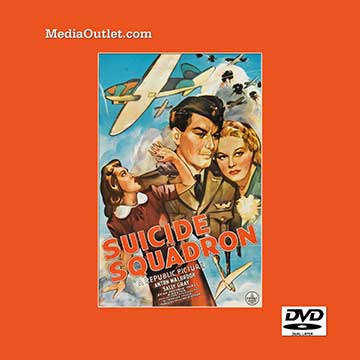
November 18, 1860 (November 6, 1860
[O.S.]): #BOTD: #HBD! Ignace Paderewski, Polish composer, pianist,
politician, statesman, patriot and spokesman for Polish
independence, 2nd Prime Minister of Poland (d. June 29, 1941) is
#born in Kurylowka, Podolia, Poland. Ignace Paderewski was a
favorite of concert audiences around the world. His musical fame
opened access to diplomacy and the media. Paderewski played an
important role in meeting with President Woodrow Wilson and
obtaining the explicit inclusion of independent Poland as point 13
in Wilson's peace terms in 1918, called the Fourteen Points. He
was the prime minister of Poland and also Poland's foreign
minister in 1919, and represented Poland at the Paris Peace
Conference in 1919. He served 10 months as prime minister, and
soon thereafter left Poland, never to return. In 1922 he retired
from politics and returned to his musical life. His first concert
after a long break, held at Carnegie Hall, was a significant
success. He also filled Madison Square Garden (20,000 seats) and
toured the United States in a private railway car. After
Pilsudski's coup d'etat in 1926, Paderewski became an active
member of the opposition to Sanacja rule in Poland. In 1936 a
coalition of members of the opposition was signed in his mansion;
it was nicknamed the Front Morges after the name of the village.
After the Polish Defensive War of 1939, Paderewski returned to
public life. In 1940 he became the head of the National Council of
Poland, a Polish parliament in exile in London. He turned to
America for help as well. He spoke to the American people directly
over the radio, the most popular media at the time; the broadcast
carried by over a hundred radio stations in the United States and
Canada. In late 1940 he crossed the Atlantic again to advocate in
person for the cause of aiding Europe and defeating Nazism. In
1941, he witnessed a touching tribute to his artistry and
humanitarianism as US cities celebrated the 50th anniversary of
his first American tour by putting on a Paderewski Week with over
6000 concerts in his honor. The 80-year-old artist also restarted
his Polish Relief Fund and gave several concerts to gather money
for it. However, his mind was not what it had once been: scheduled
again to play Madison Square Garden, he refused to appear,
insisting that he had already played the concert, presumably
remembering the concert he had played there in the 1920s. After
the Invasion Of Poland by Nazi Germany, Paderewski returned to
public life, and n 1940 he became the head of the National Council
of Poland, a Polish parliament in exile in London. He turned to
America for help as well. He spoke to the American people directly
over the radio, the most popular media at the time; the broadcast
carried by over a hundred radio stations in the United States and
Canada. In late 1940 he crossed the Atlantic again to advocate in
person for the cause of aiding Europe and defeating Nazism. In
1941, he witnessed a touching tribute to his artistry and
humanitarianism as US cities celebrated the 50th anniversary of
his first American tour by putting on a Paderewski Week with over
6000 concerts in his honor. The 80-year-old artist also restarted
his Polish Relief Fund and gave several concerts to gather money
for it. However, his mind was not what it had once been: scheduled
again to play Madison Square Garden, he refused to appear,
insisting that he had already played the concert, presumably
remembering the concert he had played there in the 1920s.
Paderewski was taken ill during one such tour, on June 27, 1941.
Despite signs of improving health and recovery from pneumonia,
Paderewski died in New York at 11:00 p.m., June 29, aged 80. He
was temporarily buried in the USS Maine Mast Memorial at Arlington
National Cemetery, in Arlington, Virginia, near Washington, D.C.
In 1992, his body was brought to Warsaw and placed in St. John's
Archcathedral. His heart is encased in a bronze sculpture in the
National Shrine of Our Lady of Czestochowa near Doylestown,
Pennsylvania. Early in 1941, the music publisher Boosey and Hawkes
had commissioned 17 prominent American or North America-resident
composers to contribute a solo piano piece each for an album to
commemorate the 50th anniversary of Paderewski's American debut in
1891. His death in June caused the album to become a posthumous
tribute to his entire life and work. Homage to Paderewski was
published in 1942. On Sale @ 15% Off Discount Till Midnight PT!
https://store.earthstation1.com/suicide-squadron-aka-dangerous-moonlight-dvd-1941-1941.html
Today's
EarthStation1.com 15% Off Commemorative Memorial Title: The Big
Four: Tycoons Of The First Transcontinental Railroad MP4 DVD
Today, November 18, 2025
November 18, 1883: Time: Time In The United States: Time Zones: Time Zones In The United States: Time Zones In Canada: -- American and Canadian railroads institute five standard continental time zones, ending the confusion of thousands of local times, based on the proposal by Connecticut school teacher Charles F. Dowd of a uniform time zone plan for the U.S. consisting of four zones. A time zone is a region of the globe that observes a uniform standard time for legal, commercial and social purposes. Time zones tend to follow the boundaries of countries and their subdivisions instead of strictly following longitude because it is convenient for areas in close commercial or other communication to keep the same time. France, including its overseas territories, has the most time zones of any country, with a total of 12. Most of the time zones on land are offset from Coordinated Universal Time (UTC) by a whole number of hours (UTC-12:00 to UTC+14:00), but a few zones are offset by 30 or 45 minutes (e.g. Newfoundland Standard Time is UTC-03:30, Nepal Standard Time is UTC+05:45, Indian Standard Time is UTC+05:30 and Myanmar Standard Time is UTC+06:30). Some higher latitude and temperate zone countries use daylight saving time for part of the year, typically by adjusting local clock time by an hour. Many land time zones are skewed toward the west of the corresponding nautical time zones. This also creates permanent daylight saving time effect. On Sale @ 15% Off Discount Till Midnight PT! https://store.earthstation1.com/bigfotyoffit.html
Today's
EarthStation1.com 15% Off Commemorative Memorial Title: Ten From
Your Show Of Shows - Sid Caesar TV Series DVD, Download, USB
Today, November 18, 2025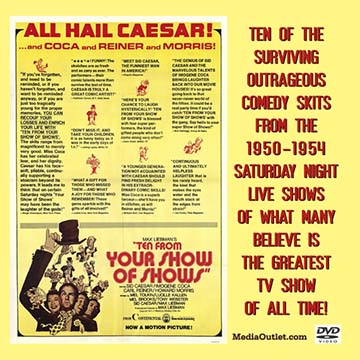
November 18, 1908: #BOTD: #HBD! Imogene
Coca, American vaudeville, cabaret, film, theater and television
actress, comedian, singer and voice actress (d. June 2, 2001) is
#born Emogeane Coca in Philadelphia, Pennsylvania, the daughter of
Joseph Fernandez Coca, a violinist and vaudeville orchestra
conductor and Sadie Brady, a dancer and magician's assistant.
Imogene Coca was a comic actress best known for her role opposite
Sid Caesar on Your Show of Shows. Starting out in vaudeville as a
child acrobat, she studied ballet and wished to have a serious
career in music and dance, graduating to decades of stage musical
revues, cabaret and summer stock. In her 40s, she began a
celebrated career as a comedian on television, starring in six
series and guest starring on successful television programs from
the 1940s to the 1990s. She was nominated for five Emmy Awards for
Your Show of Shows, winning Best Actress in 1951 and singled out
for a Peabody Award for excellence in broadcasting in 1953. Coca
was also nominated for a Tony Award in 1978 for On the Twentieth
Century and received a sixth Emmy nomination at the age of 80 for
an episode of Moonlighting. She possessed a rubbery face capable
of the broadest expressions; Life magazine compared her to
Beatrice Lillie and Charlie Chaplin and described her
characterizations as taking "people or situations suspended
in their own precarious balance between dignity and absurdity, and
push(ing) them over the cliff with one single, pointed gesture".
The magazine noted a "particularly high-brow critic" as
observing, "The trouble with most comedians who try to do
satire is that they are essentially brash, noisy and indelicate
people who have to use a sledge hammer to smash a butterfly. Miss
Coca, on the other hand, is the timid woman who, when aroused, can
beat a tiger to death with a feather." Aside from vaudeville,
cabaret, film, theater and television, she voiced children's
cartoons and was even featured in the 1984 MTV music video "Bag
Lady" by the band EBN-OZN, ultimately working well into her
80s. In a 1999 interview, Robert Ozn said during the shoot she was
required to sit on the sidewalk in snow for hours during a
blizzard with 15 degree temperatures. "While the rest of us
20-somethings were moaning about the weather, warming ourselves by
a heater, this little 75-year-old lady never once complained - put
us all to shame. She was the most professional artist I've ever
worked with." Imogene Coca died at her home in Westport,
Connecticut, aged 92, from natural causes incidental to
Alzheimer's disease. She was cremated and her were ashes scattered
in an undisclosed location. On Sale @ 15% Off Discount Till
Midnight PT!
https://store.earthstation1.com/ten-from-your-show-of-shows-tv-show-movie-dvd.html
Today's
EarthStation1.com 15% Off Commemorative Memorial Title: World War
1 TV Series With Robert Ryan DVD, Video Download, USB Drive
Today, November 18, 2025
November 18, 1916: The European Civil
War: World War I: The First European War (The European Theater Of
World War I): The Western Front Of World War I: The Battle Of The
Somme (The Somme Offensive, The First Battle Of The Somme): --
After one of the deadliest battles in human history, Allied
General and British Expeditionary Force commander Douglas Haig
calls off the battle, after five months of fierce and nearly
fruitless fighting. The Allies advanced a mere 125 square miles
after more than three million men fought in the battle, at a cost
of one million killed or wounded: 420,000 British, 195,000 French
soldiers, and over 650,000 German total casualties. On the first
day of the battle on July 1, the British Army suffered 19,240
soldiers killed and 38,230 wounded, the worst casualties suffered
in the history of the British Army. The Battle Of The Somme
(French: Bataille de la Somme), also known as the Somme offensive,
was a battle of the First World War fought by the armies of the
British Empire and French Third Republic against the German
Empire. It took place between July 1 and November 18, 1916 on both
sides of the upper reaches of the Somme, a river in France. The
French and British had committed themselves to an offensive on the
Somme during the Chantilly Conference in December 1915. The Allies
agreed upon a strategy of combined offensives against the Central
Powers in 1916 by the French, Russian, British and Italian armies,
with the Somme offensive as the Franco-British contribution.
Initial plans called for the French army to undertake the main
part of the Somme offensive, supported on the northern flank by
the Fourth Army of the British Expeditionary Force (BEF). When the
Imperial German Army began the Battle Of Verdun on the Meuse on 21
February 1916, French commanders diverted many of the divisions
intended for the Somme and the "supporting" attack by
the British became the principal effort. The British troops on the
Somme comprised a mixture of the remains of the pre-war army, the
Territorial Force and Kitchener's Army, a force of wartime
volunteers. On the first day on the Somme, the German 2nd Army
suffered a serious defeat opposite the French Sixth Army, from
Foucaucourt-en-Santerre south of the Somme to Maricourt on the
north bank and by the Fourth Army from Maricourt to the vicinity
of the Albert-Bapaume road. Most of the British casualties were
suffered on the front between the Albert-Bapaume road and
Gommecourt to the north, which was the area where the principal
German defensive effort (Schwerpunkt) was made. The battle became
notable for the importance of air power and the first use of the
tank in September but these were a product of new technology and
exceedingly unreliable. At the end of the battle, British and
French forces had penetrated 6 mi (10 km) into German-occupied
territory along the majority of the front, their largest
territorial gain since the First Battle of the Marne in 1914. The
operational objectives of the Anglo-French armies were
unfulfilled, as they failed to capture Peronne and Bapaume, where
the German armies maintained their positions over the winter.
British attacks in the Ancre valley resumed in January 1917 and
forced the Germans into local withdrawals to reserve lines in
February before the strategic retreat by about 25 mi (40 km) in
Operation Alberich to the Siegfriedstellung (Hindenburg Line) in
March 1917. Debate continues over the necessity, significance and
effect of the battle. On Sale @ 15% Off Discount Till Midnight PT!
https://store.earthstation1.com/world-war-1-robert-ryan-4-dual-layer-dvds-26-episode-tv-se1426.html
Today's
EarthStation1.com 15% Off Commemorative Memorial Title: Outer
Space Films 1 Project Mercury Start To Finish DVD, Download, USB
Today, November 18, 2025
November 18, 1923: #BOTD: #HBD! Alan
Shepard, American Rear Admiral, test pilot, naval aviator,
businessman and astronaut (d. July 21, 1998) is #born Alan
Bartlett Shepard Jr. in Derry, New Hampshire. A graduate of the
United States Naval Academy at Annapolis, Shepard saw action with
the surface navy during World War II. He became a naval aviator in
1946, and a test pilot in 1950. He was selected as one of the
original NASA Mercury Seven astronauts in 1959, and in May 1961 he
made the first manned Project Mercury flight, MR-3, in a
spacecraft he named Freedom 7. His craft entered space, but did
not achieve orbit. He became the second person, and the first
American, to travel into space, and the first person to manually
control the orientation of his spacecraft. Shepard was designated
as the commander of the first manned Project Gemini mission, but
was grounded in 1963 due to Meniere's disease, an inner-ear
ailment that caused episodes of extreme dizziness and nausea. This
was surgically corrected in 1969, and in 1971, Shepard commanded
the Apollo 14 mission, piloting the Apollo Lunar Module Antares to
the most accurate landing of the Apollo missions. At age 47, he
became the fifth and oldest person to walk on the Moon, and the
only one of the Mercury Seven astronauts to do so. During the
mission, he hit two golf balls on the lunar surface. He was Chief
of the Astronaut Office from November 1963 to July 1969 (the
approximate period of his grounding), and from June 1971 until his
retirement from the United States Navy and NASA on August 1, 1974.
He was promoted to rear admiral on August 25, 1971, the first
astronaut to reach that rank. Alan Shepard of from complications
of chronic lymphocytic leukemia in Pebble Beach, California, aged
74. Shepard's widow Louise had planned to cremate his remains and
scatter the ashes, but before she was able to do that, she herself
died from a heart attack on August 25, 1998, at 17:00, which,
coincidentally, was the same time of day at which he had always
phoned her when they were apart. They had been married for 53
years. Their family decided to cremate them both, and their ashes
were scattered, together, from a Navy helicopter, over Stillwater
Cove, in front of their Pebble Beach home. On Sale @ 15% Off
Discount Till Midnight PT!
https://store.earthstation1.com/outer-space-films-1-project-mercury-start-to-finish-dv1.html
Today's
EarthStation1.com 15% Off Commemorative Memorial Title: John L.
Lewis Documentary Biography DVD, Video Download, USB Drive
Today, November 18, 2025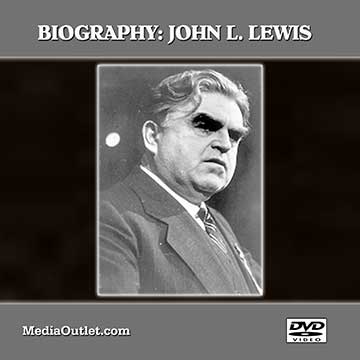
November 18, 1938: Organized Labor: The
Labor Union Movement: The Labor Union Movement In The United
States: The Labor History Of The United States: Labor Unions In
The United States: The Congress Of Industrial Organizations (CIO):
-- Trade union members elect John L. Lewis as the first president
of the Congress of Industrial Organizations. John L. Lewis,
American miner and organized labor union leader (February 12, 1880
- June 11, 1969) who served as president of the United Mine
Workers of America (UMW) from 1920 to 1960, was born John
Llewellyn Lewis in Cleveland, Lucas County, Iowa. A major player
in the history of coal mining, he was the driving force behind the
founding of the Congress of Industrial Organizations (CIO), which
established the United Steel Workers of America and helped
organize millions of other industrial workers in the 1930s. After
resigning as head of the CIO in 1941, he took the Mine Workers out
of the CIO in 1942 and in 1944 took the union into the American
Federation Of Labor (AFL). A leading liberal, he played a major
role in helping Franklin D. Roosevelt win a landslide in 1936, but
as an isolationist, broke with Roosevelt in 1940 on FDR's
anti-Nazi foreign policy. Lewis was a brutally effective and
aggressive fighter and strike leader who gained high wages for his
membership while steamrolling over his opponents, including the
United States government. Lewis was one of the most controversial
and innovative leaders in the history of labor, gaining credit for
building the industrial unions of the CIO into a political and
economic powerhouse to rival the AFL, yet was widely hated by
calling for nationwide coal strikes which critics believed
damaging to the American economy and war effort. His massive
leonine head, forest-like eyebrows, firmly set jaw, powerful voice
and ever-present scowl thrilled his supporters, angered his
enemies, and delighted cartoonists. Coal miners for 40 years
hailed him as their leader, whom they credited with bringing high
wages, pensions and medical benefits. Lewis retired to his family
home, the Lee-Fendall House in Alexandria, Virginia, where he had
lived since 1937. He lived there until his death on June 11, 1969.
His passing elicited many kind words and fond remembrances, even
from former rivals. "He was my personal friend," wrote
Reuben Soderstrom, the President of the Illinois AFL-CIO, who had
once lambasted Lewis as an "imaginative windbag," upon
news of his death. Lewis, he said, would forever be remembered for
"making almost a half million poorly paid and poorly
protected coal miners the best paid and best protected miners in
all the world." He is buried in Oak Ridge Cemetery,
Springfield, Illinois. On Sale @ 15% Off Discount Till Midnight
PT!
https://store.earthstation1.com/john-l-lewis-dvd-united-mine-workers-afl-cio.html
Today's
EarthStation1.com 15% Off Commemorative Memorial Title: Black
Civil Rights Films: African-American History DVD, MP4, USB Stick
Today, November 18, 2025
November 18, 2004: #DOTD: Bobby Frank
Cherry, American white supremacist, terrorist, and Ku Klux Klan
member, convicted on May 22, 2002, by a Birmingham, Alabama jury
of murder for his role in the 16th Street Baptist Church bombing
in 1963 (b. June 20, 1930) #dies in The Kilby Correctional
Facility in Mt. Meigs, Alabama's hospital unit. aged 74. He is
buried in Payne Springs Cemetery in Henderson County, Texas. Frank
Cherry was born in Mineral Springs, a neighborhood of Clanton,
Alabama, on the same calendar date of his fellow bombing
conspirator Thomas Edwin Blanton Jr. The bombing killed four young
African American girls (Carole Robertson, Cynthia Wesley, Addie
Mae Collins, and Denise McNair) and injured more than 20 other
people. The 16th Street Baptist Church bombing was an act of white
supremacist terrorism which occurred at the African American 16th
Street Baptist Church in Birmingham, Alabama, on Sunday, September
15, 1963, when four members of the Ku Klux Klan planted at least
15 sticks of dynamite attached to a timing device beneath the
steps located on the east side of the church. Described by Martin
Luther King Jr. as "one of the most vicious and tragic crimes
ever perpetrated against humanity", the explosion at the
church killed four girls and injured 22 others. Although the FBI
had concluded in 1965 that the 16th Street Baptist Church bombing
had been committed by four known Ku Klux Klansmen and
segregationists - Thomas Edwin Blanton Jr., Herman Frank Cash,
Robert Edward Chambliss, and Bobby Frank Cherry - no prosecutions
ensued until 1977, when Robert Chambliss was tried and convicted
of the first degree murder of one of the victims, 11-year-old
Carol Denise McNair. Thomas Edwin Blanton Jr. and Bobby Cherry
were each convicted of four counts of murder and sentenced to life
imprisonment in 2001 and 2002 respectively,] whereas Herman Cash,
who died in 1994, was never charged with his alleged involvement
in the bombing. The 16th Street Baptist Church bombing marked a
turning point in the United States during the civil rights
movement and contributed to support for passage of the Civil
Rights Act Of 1964. On Sale @ 15% Off Discount Till Midnight PT!
https://store.earthstation1.com/black-civil-rights-films-africanamerican-history-dvd.html
Today's
EarthStation1.com 15% Off Commemorative Memorial Title: Jim Jones:
Jonestown Speeches & Suicide Recording CD, Download, USB
Today, November 18, 2025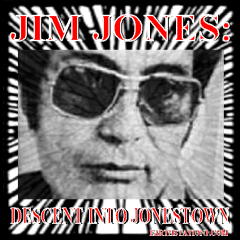
November 18, 1978: #DOTD: #RIP: Religion:
The History Of Religion: Abrahamic Religions: Christianity: The
History Of Christian Fundamentalism (Fundamental Christianity,
Fundamentalist Christianity): Eschatology (The End Of The World,
The End Times): Cults: Religious Cults: Apocalypticism:
Apocalyptic Cults: Mass Suicides: The Peoples Temple Of The
Disciples Of Christ (The Peoples Temple Full Gospel Church, The
Peoples Temple): The Peoples Temple Agricultural Project
(Jonestown): Mass Suicides: The Jonestown Mass Suicide: -- In
Jonestown, Guyana, Jim Jones led his Peoples Temple to a mass
murder-suicide that claimed 918 lives in all, including himself,
909 of them in Jonestown itself, including over 270 children.
Congressman Leo Ryan is murdered by members of the Peoples Temple
hours earlier. The Peoples Temple Agricultural Project, better
known by its informal name "Jonestown", was a remote
settlement established by the Peoples Temple, a San
Francisco-based cult under the leadership of Jim Jones, in Guyana.
The settlement became internationally known when, on November 18,
1978, a total of 918 people died at the settlement, at the nearby
airstrip in Port Kaituma, and at a Temple-run building in
Georgetown, Guyana's capital city. The name of the settlement
became synonymous with the incidents at those locations. In total,
909 individuals died in Jonestown, all but two from apparent
cyanide poisoning, in an event termed "revolutionary suicide"
by Jones and some Peoples Temple members on an audio tape of the
event, and in prior recorded discussions. The poisonings in
Jonestown followed the murder of five others by Temple members at
Port Kaituma, including United States Congressman Leo Ryan, an act
that Jones ordered. Four other Temple members committed
murder-suicide in Georgetown at Jones' command. Terms used to
describe the deaths in Jonestown and Georgetown evolved over time.
Many contemporary media accounts after the events called the
deaths a mass suicide. In contrast, most sources today refer to
the deaths with terms such as mass murder-suicide, a massacre, or
simply mass murder. Seventy or more individuals at Jonestown were
injected with poison, and a third of the victims (304) were
minors. Guards armed with guns and crossbows had been ordered to
shoot those who fled the Jonestown pavilion as Jones lobbied for
suicide. Jonestown resulted in the largest single loss of American
civilian life in a deliberate act until September 11, 2001. Jim
Jones' remains were cremated, and the ashes scattered at sea,
along with seven others who died in the 1978 Jonestown Massacre,
by long-time funeral director Bill Torbert Sr. from a
single-engine Piper plane on a spring day in 1979 across the
Atlantic Ocean, a mile off of Bethany Beach, Delaware. "After
the ashes were put in the ocean, we couldn't close the door,"
Torbert said. "We had to hold it until it landed." More
than 400 unclaimed bodies of the Jonestown mass suicide are buried
at Evergreen Cemetery in Oakland, California. In 2011, four
additional memorial plaques were placed at the site with the names
of all 918 people who died in the incident. The new memorial
controversially includes the name of Jim Jones, the leader who
ordered the mass suicide. The organizers intended the memorial to
be "for historical purposes, listing everyone who died
there," including the news reporters and Rep. Leo Ryan. On
Sale @ 15% Off Discount Till Midnight PT!
https://store.earthstation1.com/jim-jones-jonestown-speeches-amp-complete-suicide-audio-cd.html
Today's
EarthStation1.com 15% Off Commemorative Memorial Title: The
Yellowstone Fires Of 1988 Documentary DVD, Download, USB Drive
Today, November 18, 2025
November 18, 1988: Natural Disasters:
Natural Disasters In The United States: Fires: Conflagrations:
Conflagrations In The United States: Wildfires (Forest Fires,
Bushfires, Brushfires, Wildland Fires, Rural Fires): Wildfires In
The United States: The Yellowstone Fires Of 1988: -- All fires in
Yellowstone were officially declared out, ending the Yellowstone
Fires Of 1988. The Yellowstone Fires Of 1988 (June 14, 1988 -
November 18, 1988) collectively formed the largest wildfire in the
recorded history of Yellowstone National Park in the United
States. Starting as many smaller individual fires, the flames
quickly spread out of control due to drought conditions and
increasing winds, combining into one large conflagration which
burned for several months. The fires almost destroyed two major
visitor destinations and, on September 8, 1988, the entire park
closed to all non-emergency personnel for the first time in its
history. Only the arrival of cool and moist weather in the late
autumn brought the fires to an end. A total of 793,880 acres
(3,213 km2), or 36 percent of the park, was affected by the
wildfires. Thousands of firefighters fought the fires, assisted by
dozens of helicopters and fixed-wing aircraft which were used for
water and fire retardant drops. At the peak of the effort, more
than 9,000 firefighters were assigned to the park. With fires
raging throughout the Greater Yellowstone Ecosystem and other
areas in the western United States, the staffing levels of the
National Park Service and other land management agencies were
inadequate for the situation; more than 4,000 U.S. military
personnel were soon brought in to assist in wildfire suppression
efforts. The firefighting effort cost 120M USD (260M USD in 2020).
Losses to structures were minimized by concentrating firefighting
efforts near major visitor areas, keeping property damage down to
3M USD (6M USD as of 2020). No firefighters died while fighting
the Yellowstone fires, though there were two fire-related deaths
outside the park. Before the late 1960s, fires were generally
believed to be detrimental for parks and forests, and management
policies were aimed at suppressing fires as quickly as possible.
However, as the beneficial ecological role of fire became better
understood in the decades before 1988, a policy was adopted of
allowing natural fires to burn under controlled conditions, which
proved highly successful in reducing the area lost annually to
wildfires. In contrast, in 1988, Yellowstone was overdue for a
large fire, and, in the exceptionally dry summer, many smaller
"controlled" fires combined. The fires burned
discontinuously, leaping from one patch to another, leaving
intervening areas untouched. Intense fires swept through some
regions, burning everything in their paths. Tens of millions of
trees and countless plants were killed by the wildfires, and some
regions were left looking blackened and dead. However, more than
half of the affected areas were burned by ground fires, which did
less damage to hardier tree species. Not long after the fires
ended, plant and tree species quickly reestablished themselves,
and native plant regeneration has been highly successful. The
Yellowstone Fires Of 1988 were unprecedented in the history of the
National Park Service, and led to many questions about existing
fire management policies. Media accounts of mismanagement were
often sensational and inaccurate, sometimes wrongly reporting or
implying that most of the park was being destroyed. While there
were temporary declines in air quality during the fires, no
adverse long-term health effects have been recorded in the
ecosystem and, contrary to initial reports, few large mammals were
killed by the fires, though there was a subsequent reduction in
the number of moose which has yet to rebound. On Sale @ 15% Off
Discount Till Midnight PT!
https://store.earthstation1.com/the-yellowstone-fires-of-1988-documentary1988.html
Today's
EarthStation1.com #OnThisDay Commemorative Memorial Title: Behind
The Horoscope: Validating Natal Astrology DVD, MP4, USB Drive
Today, November 18, 2025 November 18: Married To A Scorpio Support
Day: -- Today provides an opportunity to share stories, guidance,
and support those with Scorpio spouses. Scorpio is the zodiac sign
for people born between October 23 to November 22. Every zodiac
sign has a specific list of characteristics that tend to manifest
in people's personalities. Being married to a Scorpio, while
amazing, is not an easy feat. They are very loyal, but they also
have some intense traits. Having a Scorpio partner can come with
its fair share of baggage because they can be manipulative, have
intense mood swings, and can be very impulsive. Astrology has
played a crucial role in determining human behavior, worldviews
and established many rituals. Before the invention of science and
technology, humans had only the sky and their natural environment
to seek answers about the world. Astrology became a way for early
humans to look at the sky, patterns of the stars, and the moon's
cycles to find meaning about their existence and the workings of
the vast and unknown world. Astrology has its roots dating back to
the third millennium B.C. where West Eurasian people took cues
from astronomical cycles to form calendars and navigate the
sequence of seasons. Astrology's influence was far-reaching. In
13th-century Europe, astrology was a part of medical treatment,
and doctors studied the stars and celestial cycles to formulate
their treatment. By the 1500s in Europe, a law stated physicians
had to calculate the moon's position before performing complex
medical procedures, like surgery. Astrology's validity as an
authentic and legitimate field of knowledge started decreasing by
the 17th century due to science and astronomy emerging. Several
scientific concepts that were based on hard, quantifiable facts
ruled out many of the assumptions astrology had been perpetuating.
Astrology slowly became relegated to the category of
pseudoscience, however, it saw a rise in popularity again in the
20th century when it started being supplied as newspaper
horoscopes and zodiac signs. We now see zodiac signs as one of the
biggest influencing factors behind one's personality.
https://store.earthstation1.com/behind-the-horoscope-dvd-astrology-investigation-documentary.html
November 18: Married To A Scorpio Support
Day: -- Today provides an opportunity to share stories, guidance,
and support those with Scorpio spouses. Scorpio is the zodiac sign
for people born between October 23 to November 22. Every zodiac
sign has a specific list of characteristics that tend to manifest
in people's personalities. Being married to a Scorpio, while
amazing, is not an easy feat. They are very loyal, but they also
have some intense traits. Having a Scorpio partner can come with
its fair share of baggage because they can be manipulative, have
intense mood swings, and can be very impulsive. Astrology has
played a crucial role in determining human behavior, worldviews
and established many rituals. Before the invention of science and
technology, humans had only the sky and their natural environment
to seek answers about the world. Astrology became a way for early
humans to look at the sky, patterns of the stars, and the moon's
cycles to find meaning about their existence and the workings of
the vast and unknown world. Astrology has its roots dating back to
the third millennium B.C. where West Eurasian people took cues
from astronomical cycles to form calendars and navigate the
sequence of seasons. Astrology's influence was far-reaching. In
13th-century Europe, astrology was a part of medical treatment,
and doctors studied the stars and celestial cycles to formulate
their treatment. By the 1500s in Europe, a law stated physicians
had to calculate the moon's position before performing complex
medical procedures, like surgery. Astrology's validity as an
authentic and legitimate field of knowledge started decreasing by
the 17th century due to science and astronomy emerging. Several
scientific concepts that were based on hard, quantifiable facts
ruled out many of the assumptions astrology had been perpetuating.
Astrology slowly became relegated to the category of
pseudoscience, however, it saw a rise in popularity again in the
20th century when it started being supplied as newspaper
horoscopes and zodiac signs. We now see zodiac signs as one of the
biggest influencing factors behind one's personality.
https://store.earthstation1.com/behind-the-horoscope-dvd-astrology-investigation-documentary.html
Today's
EarthStation1.com #OnThisDay Commemorative Memorial Title: The
Nobel Century Nobel Prize History TV Series DVD, MP4, USB Stick
Today, November 18, 2025November 18: European Antibiotic
Awareness Day: -- Encourages the responsible use of antibiotics.
The day also aims to increase awareness of global antimicrobial
resistance. The invention of antibiotics is always listed as one
of the greatest medical discoveries ever. People could now cure
once-feared bacterial infections. In 1929, Sir Alexander Fleming
discovered penicillin, the world's first antibiotic. The drug
became widely popular after WWII. Some statistics suggest this
"miracle drug" saved an estimated 200 million lives.
Penicillin is also partly responsible for the prosperity that
people experienced in developed countries around this time. Today,
there are over 100 types of antibiotics. On the one hand, it's
good news that antibiotics can cure so many different kinds of
infections. On the one hand, antibiotics do effectively treat many
different kinds of infections. However, on the other hand, people
have become dependent on antibiotics. As a result, some people
have become resistant to antibiotics. Superbugs have also made an
appearance and are growing in number. These types of bacteria are
highly resistant to antibiotics. The latest statistics show that
33,000 people a year die from an infection because of antibiotic
resistance. Misuse and overuse of antibiotics accelerate
resistance strains. Implementing solutions now will help curb the
growing problem. The European Center for Disease Prevention and
Control established European Antibiotic Awareness Day in 2008.
They chose November 18th, as it coincides with the World Health
Organization's antibiotics awareness week. This week is held each
year from November 13-19.
https://store.earthstation1.com/the-nobel-century-nobel-prize-history-tv-series-dvd-mp4-us4.html
Today's
EarthStation1.com #OnThisDay Commemorative Memorial Title: Haiti:
Killing The Dream 1991 Haitian Coup + Bonus MP4 Download DVD
Today, November 18, 2025November 18: The Battle Of Vertieres Day:
-- November 18, 1803: The Age Of Enlightenment (The Enlightenment,
The Age Of Reason): The Age Of Revolution: The Atlantic
Revolutions: The American Enlightenment: The Haitian Revolution:
The Saint-Domingue Expedition: The Battle Of Vertieres: -- The
Battle Of Vertieres is fought, the last major battle of the
Haitian Revolution, and the final part of the Revolution under
Jean Jacques Dessalines, a battle leading to the establishment of
the Republic of Haiti, the first black republic in the Western
Hemisphere. It was fought on a single day between the enslaved
Haitian army and Napoleon's French expeditionary forces, who were
committed to regaining control of the island, an expedition that
Napoleon later said was his greatest regret. Vertieres is situated
just south of Cap-Haitien (known then as Cap-Francais), in the
Departement du Nord, Haiti. By the end of October 1803, the forces
fighting the expeditionary troops had already taken over most of
the territory of St. Domingue. The only places controlled by the
French forces were Mole St. Nicolas, held by Noailles, and
Cap-Francais, where, with 5,000 troops, French General Rochambeau
was at bay.
https://store.earthstation1.com/haiti-killing-the-dream-the-1991-haitian-coup-dvd-download1991.html
Today's
EarthStation1.com #OnThisDay Commemorative Memorial Title:
Hizzoner The Mayor Jimmy Walker & Fiorello La Guardia MP4
Download DVD
Today, November 18, 2025November 18, 1946: #DOTD: #RIP: Jimmy
Walker, known colloquially as Beau James, songwriter, record
executive and mayor of New York City from 1926 to 1932 (b. June
19, 1881) #dies in New York City at the age of 65 of a brain
hemorrhage. He is interred in the Gate of Heaven Cemetery in
Hawthorne, New York. A flamboyant politician, James John Walker
was a liberal Democrat and part of the powerful Tammany Hall
machine. He was forced to resign during a corruption scandal
mayor. Jimmy Walker was born James John Walker in New York City,
the son of Irish-born William H. Walker, a carpenter and
lumberyard owner who was very active in local politics as a
Democratic assemblyman and alderman from Greenwich Village,
belying certain accounts of Walker's childhood that stated he grew
up in poverty. Walker's first passion seems to be music; in 1905
he stormed Tin Pan Alley writing songs such as "There's Music
In The Rustle Of A Skirt" and "Will You Love Me in
December As You Do in May?". Walker was not the best of
students and dropped out of college before eventually graduating
from New York Law School in 1904. Walker's father wanted him to
become a lawyer and politician. Raised in Greenwich Village among
the bohemians, Walker at first decided that he would rather write
songs and be involved in the music industry, writing many songs,
including "There's Music In The Rustle Of A Skirt" and
the 1908 hit "Will You Love Me in December as You Do in
May?". Nevertheless, he eventually entered politics in 1909
and subsequently passed the bar exam in 1912. Walker was a member
of the New York State Assembly (New York Co., 5th D.) from
1910-1914. He was a member of the New York State Senate from 1915
to 1925, and was Minority Leader from 1920 to 1922; Temporary
President of the State Senate from 1923 to 1924; and Minority
Leader again in 1925. In the Senate he strongly opposed
Prohibition. He also sponsored the "Walker Law" to
legalize boxing in New York. He was honored a number of times over
the years by the boxing community. Walker is a member of the
International Boxing Hall of Fame and was given the Edward J. Neil
Trophy in 1945 for his service to the sport. After his years in
the Senate, Walker set his sights on the 1925 election for Mayor
of New York and ran against fellow democrat and incumbant John
Francis Hylan. Walker's reputation as a flamboyant man-about-town
made him a hero to many working-class voters; he was often seen at
legitimate theaters and illegitimate speakeasies. Walker was a
clothes horse: his valet packed 43 suits for his trip to Europe in
August 1927. On the other hand, his reputation for tolerating
corruption made him suspect to middle-class and moralistic voters.
Governor Alfred E. Smith was his mentor. Smith was a staunch
supporter since Walker backed many social and cultural issues that
were considered politically important such as social welfare
legislation, legalization of boxing, repeal of blue laws against
Sunday baseball games, condemning the Ku Klux Klan, and especially
their mutual opposition to Prohibition. Smith developed a
successful strategy for Walker to win the election and guided
Walker's every move to overcome his tarnished reputation. Smith
used his base in the strong political machine of Tammany Hall to
secure this victory. Walker had to change some of his more
unscrupulous ways or at least provide a cover for his
indiscretions. As with many of the things in Walker's life, he
chose the latter. Instead of ending his visits to the speakeasies
and his friendships with chorus girls, he took those activities
behind the closed doors of a penthouse funded by Tammany Hall.
Walker defeated Hylan in the Democratic primary, and after
defeating Republican mayoral candidate Frank D. Waterman in the
general election, became mayor of New York City. In his initial
years as mayor, Walker saw the city prosper and many public works
projects gain traction. In his first year, Walker created the
Department of Sanitation, unified New York's public hospitals,
improved many parks and playgrounds, and guided the Board of
Transportation to enter into contract for the construction of an
expanded subway system (the Independent Subway System or IND).
Under Walker's administration, new highways and a dock for
superliners were also built. He even managed to maintain the
five-cent subway fare despite a threatened strike by the workers.
However, Walker's term was also known for the proliferation of
speakeasies during Prohibition. It is a noted aspect of his career
as mayor and as a member of the State Senate that Walker was
strongly opposed to Prohibition. As mayor, Walker led his
administration in challenging the Eighteenth Amendment by
replacing the police commissioner with an inexperienced former
state banking commissioner. The new police commissioner
immediately dissolved the Special Service Squad. Since Walker did
not feel that drinking was a crime, he discouraged the police from
enforcing Prohibition law or taking an active role unless it was
to curb excessive violations or would prove to be newsworthy. His
affairs with "chorus girls" were widely known, and he
left his wife, Janet, for showgirl Betty Compton. Walker was
re-elected by an overwhelming margin in 1929, defeating Socialist
Norman Thomas. Walker's fortunes turned downward with the economy
after the stock-market crash of 1929. Patrick Joseph Hayes, the
Cardinal Archbishop of New York, denounced him, implying that the
immorality of the mayor, both personal and political in tolerating
"girlie magazines" and casinos was a cause of the
economic downturn. It was one of the causes that led to Tammany
Hall's pulling its support for Walker. Increasing social unrest
led to investigations into corruption within his administration,
and he was eventually forced to testify before the investigative
committee of Judge Samuel Seabury, the Seabury Commission (also
known as the Hofstadter Committee). Walker caused his own downfall
by accepting large sums of money from businessmen looking for
municipal contracts. One surprise witness in the Seabury
investigation was Vivian Gordon. She informed the investigators
that women were falsely arrested and accused of prostitution by
the New York City Police Department. Police officers were given
more money in their paychecks. After her testimony, Gordon was
suspiciously found strangled to death in a park in the Bronx. That
demonstrated to New Yorkers that corruption could lead to terrible
consequences and that Walker might ultimately, in some way, be
responsible for her death. With New York City appearing as a
symbol of corruption under Mayor Walker, Governor Franklin D.
Roosevelt knew he had to do something about Walker and his
administration. Knowing that the State constitution could allow an
elected mayor to be removed from office, Roosevelt felt compelled
to do so but risked losing Tammany Hall's support for the
Democratic nomination. On the other hand, if Roosevelt did nothing
or let Walker off, the national newspapers would consider him
weak. Facing pressure from Roosevelt, Walker eluded questions
about his personal bank accounts, stating instead that the amounts
he received were "beneficences" and not bribes. He
delayed any personal appearances until after Roosevelt's
nomination was secured. It was then that the embattled mayor could
fight no longer. Months from his national election, Roosevelt
decided that he must remove Walker from office. Walker agreed and
resigned on September 1, 1932. He went on a grand tour of Europe
with Compton, his Ziegfeld girl. He announced on November 12,
1932, while aboard the SS Conte Grande, that he had "no
desire or intention of ever holding public office again."
Walker stayed in Europe until the danger of criminal prosecution
appeared remote. There, he married Compton. After his return to
the United States, Walker acted as head of Majestic Records, which
enjoyed its greatest commercial success in the 1940s until
expansion and supply problems created financial problems, when it
folded in 1948, two years after Walker's death. Majestic Records
featured such popular performing artists as Jimmie Lunceford,
Louis Prima, Bud Freeman, Eddy Howard, the DeMarco Sisters, George
Paxton, Foy Willing and the Riders of the Purple Sage, the Merry
Macs and more. Walker died at the age of 65 of a brain hemorrhage.
He was interred in the Gate of Heaven Cemetery in Hawthorne, New
York. A romanticized version of Walker's tenure as mayor was
presented in the 1957 film Beau James, starring Bob Hope. This was
a somewhat accurate depiction of Walker, who during his time as
mayor had become a symbol of the jazz age romanticism. The film
was based on a biography of Walker, also titled Beau James,
written by Gene Fowler. A song by Dean Martin, similarly titled
"Beau James", presented a highly idealized and romantic
interpretation of his tenure as mayor. A book was also the basis
of Jimmy, a stage musical about Walker that had a brief Broadway
run from October 1969 to January 1970. The show starred Frank
Gorshin as Walker and Anita Gillette as Betty Compton. There is
also a song about Walker in the stage musical Fiorello!,
"Gentleman Jimmy". Footage of Walker is used in the 1983
Woody Allen film Zelig, with Walker being one of the guests during
Zelig's visit to William Randolph Hearst's mansion in San Simeon,
California. The 1935 novel It Can't Happen Here, by Sinclair
Lewis, lists the exiles in Paris as "Jimmy Walker, and a few
ex-presidents from South America and Cuba".
https://store.earthstation1.com/perspective-on-greatness-hizzoner-the-mayor-laguardia-walker-nyc-dvd.html
Today's
EarthStation1.com #OnThisDay Commemorative Memorial Title: Minnie
The Moocher And Many Many More DVD, Video Download, Flash Drive
Today, November 18, 2025November 18, 1994: #DOTD: #RIP: Cab
Calloway, African American jazz singer and bandleader (b. December
25, 1907) #dies from pneumonia a month before his 87th Christmas
day birthday at a nursing home in Hockessin, Delaware, where he
had been admitted after suffering a stroke at his home in
Westchester County, New York on June 12, 1994. He was survived by
his wife, five daughters, and seven grandsons. Calloway is buried
at Ferncliff Cemetery in Hartsdale, New York. Cab Calloway was
born Cabell Calloway III in Rochester, New York. He was strongly
associated with the Cotton Club in Harlem, New York City, where he
was a regular performer. Calloway was a master of energetic scat
singing and led one of the United States' most popular big bands
from the start of the 1930s to the late 1940s. Calloway's band
featured performers including trumpeters Dizzy Gillespie and
Adolphus "Doc" Cheatham, saxophonists Ben Webster and
Leon "Chu" Berry, New Orleans guitarist Danny Barker,
and bassist Milt Hinton. Calloway continued to perform until his
death in 1994 at the age of 86. In 1931 Calloway recorded his most
famous song, "Minnie the Moocher". That song, along with
"St. James Infirmary Blues" and "The Old Man of the
Mountain", were performed for Max and Dave Fleischer's Betty
Boop animated shorts Minnie the Moocher (1932), Snow White (1933),
and The Old Man of the Mountain (1933), respectively. Through
rotoscoping, Calloway performed voiceover for these cartoons, but
his dance steps were the basis of the characters' movements. He
took advantage of this, timing concerts in some communities to
coincide with the release of the films in order to make the most
of the publicity. As a result of the success of "Minnie the
Moocher", Calloway became identified with its chorus, gaining
the nickname "The Hi De Ho Man".
https://store.earthstation1.com/minnie-the-moocher-and-many-many-more-dvd-1983-cab-call1984.html
Today's
EarthStation1.com #OnThisDay Commemorative Memorial Title: Walt
Disney: The Story Of Robin Hood (1956) DVD, Download, USB Drive
Today, November 18, 2025November 18, 1247: #DOTD: #RIP: Robin
Hood, heroic outlaw in English folklore (b. c. 1160) #dies at the
approximate age of 87 (according to Joseph Ritson; see below).
Robin Hood is a legendary heroic outlaw originally depicted in
English folklore and subsequently featured in literature and film.
According to legend, he was a highly skilled archer and swordsman.
In some versions of the legend, he is depicted as being of noble
birth, and in modern retellings he is sometimes depicted as having
fought in the Crusades before returning to England to find his
lands taken by the Sheriff. In the oldest known versions he is
instead a member of the yeoman class. Traditionally depicted
dressed in Lincoln green, he is said to have robbed from the rich
and given to the poor. Through retellings, additions, and
variations, a body of familiar characters associated with Robin
Hood has been created. These include his lover, Maid Marian, his
band of outlaws, the Merry Men, and his chief opponent, the
Sheriff of Nottingham. The Sheriff is often depicted as assisting
Prince John in usurping the rightful but absent King Richard, to
whom Robin Hood remains loyal. His partisanship of the common
people and his hostility to the Sheriff of Nottingham are early
recorded features of the legend, but his interest in the
rightfulness of the king is not, and neither is his setting in the
reign of Richard I. He became a popular folk figure in the Late
Middle Ages, and the earliest known ballads featuring him are from
the 15th century (1400s). There have been numerous variations and
adaptations of the story over the subsequent years, and the story
continues to be widely represented in literature, film, and
television. Robin Hood is considered one of the best known tales
of English folklore. The historicity of Robin Hood is not proven
and has been debated for centuries. There are numerous references
to historical figures with similar names that have been proposed
as possible evidence of his existence, some dating back to the
late 13th century. At least eight plausible origins to the story
have been mooted by historians and folklorists, including
suggestions that "Robin Hood" was a stock alias used by
or in reference to bandits. Joseph Ritson (October 2, 1752 -
September 23, 1803) English antiquary who was well known for his
1795 compilation of the Robin Hood legend, assembled an account of
Robin Hood's life from the various sources available to him, and
concluded that Robin Hood was born in around 1160, and thus had
been active in the reign of Richard I. He thought that Robin was
of aristocratic extraction, with at least 'some pretension' to the
title of Earl of Huntingdon, that he was born in an unlocated
Nottinghamshire village of Locksley and that his original name was
Robert Fitzooth. Ritson gave the date of Robin Hood's death as
November 18, 1247, when he would have been around 87 years old. In
copious and informative notes Ritson defends every point of his
version of Robin Hood's life. In reaching his conclusion Ritson
relied or gave weight to a number of unreliable sources, such as
the Robin Hood plays of Anthony Munday and the Sloane Manuscript.
Nevertheless, Dobson and Taylor credit Ritson with having 'an
incalculable effect in promoting the still continuing quest for
the man behind the myth', and note that his work remains an
'indispensable handbook to the outlaw legend even now'. Ritson's
friend Walter Scott used Ritson's anthology collection as a source
for his picture of Robin Hood in Ivanhoe, written in 1818, which
did much to shape the modern legend. Robert Fitzooth or Fitzooth,
Earl of Huntingdon (alleged dates: 1160-1247), is a fictitious
identity for Robin Hood. The name was first published in William
Stukeley's Paleographica Britannica in 1746. By then the
association of Robin with the earldom of Huntingdon had become
conventional, thanks to Anthony Munday's 1598 play The Downfall of
Robert Earl of Huntingdon; it was also generally believed that he
had flourished in the reign of Richard I of England. In actual
history, David of Scotland was Earl of Huntingdon throughout
Richard's reign, succeeded by his son John. David did have a son
named Robert but he is believed to have died in infancy. Therefore
the Earl could not have been "Robin Hood". Stukeley's
genealogical "researches" then turned up a descendant of
Earl Waltheof, and therefore a rival claimant to the earldom,
related to the lords of Kyme, whom he named as Robert Fitzooth,
born in 1160 and dying in 1247: and he claimed that "Ooth"
or Odo had become corrupted into "Hood". This has been a
popular identification for later writers of fiction, beginning at
Pierce Egan the Younger's 1840 novel Robin Hood and Little John.
In Egan's story there were, genealogically, two Roberts, Earls of
Huntingdon between Waltheof and Robin Hood (to explain the
historical time gap); had Robin Hood actually taken possession of
the title, he would have been Robert III. The "disowning"
according to the storyline came about because of a younger son of
Waltheof and brother of Robert I, Philip Fitzooth, scheming to
take over the title, disowned his baby grandnephew under the
excuse that Robert II's marriage had not been recognized, thus
baby Robin (named in the storyline after one of Gilbert's brothers
when Gilbert adopted him) was raised as the son of Gilbert and his
wife. In Disney's The Story of Robin Hood and His Merrie Men
(1952), Roger Lancelyn Green's 1956 novel, and the BBC's 2006-2009
Robin Hood series, the Earl of Huntingdon fell out with King John
and was forced to flee north, taking refuge in Sherwood Forest
where he spent the rest of his days. In the 1980s ITV series Robin
of Sherwood, this Robert, made older than he would historically
have been, is David's eldest son and survives to adulthood but is
disinherited when outlawed. The name "Fitzooth" was not
applied to Robin Hood by anybody before Stukeley, nor is it
otherwise known. It is now generally believed that Stukeley forged
the Fitzooth family tree and that this Robert never existed.
Medieval references to Robin Hood made him a yeoman, not a
nobleman, although when the idea of a "disowned noble"
Robin first arose in the sixteenth century there was consensus
that Huntingdon was his earldom. At Kirklees Priory in West
Yorkshire stands an alleged grave with a spurious inscription,
which relates to Robin Hood. The ballads relate that before he
died, Robin told Little John where to bury him. He shot an arrow
from the priory window, and where the arrow landed was to be the
site of his grave. Gest states that the prioress was a relative of
Robin's. Robin was ill and staying at the priory where the
prioress was supposedly caring for him. However, she betrayed him,
his health worsened, and he eventually died there. The inscription
on the grave reads: ========= Hear underneath dis laitl stean |
Laz robert earl of Huntingtun | Ne'er arcir ver as hie sa geud |
An pipl kauld im robin heud | Sick [such] utlawz as he an iz men |
Vil england nivr si agen | Obiit 24 kal: Dekembris, 1247 |
========= Despite the unconventional spelling, the verse is in
Modern English, not the Middle English of the 13th century. The
date is also incorrectly formatted - using the Roman calendar, "24
kal Decembris" would be the 23rd day before the beginning of
December, that is, 8 November. The tomb probably dates from the
late 18th century. The grave with the inscription is within sight
of the ruins of the Kirklees Priory, behind the Three Nuns pub in
Mirfield, West Yorkshire. Though local folklore suggests that
Robin is buried in the grounds of Kirklees Priory, this theory has
now largely been abandoned by historians.
https://store.earthstation1.com/walt-disney39s-disneyland-the-story-of-robin-hood-1956-391956.html
Today's
EarthStation1.com #OnThisDay Commemorative Memorial Title: Pirates
12 Part Documentary Series MP4 Video Download DVD
Today, November 18, 2025November 18, 1720: #DOTD: Calico Jack,
English pirate captain operating in the Bahamas and Cuba during
the early 18th century era of The Golden Age Of Piracy
(1650s-1730s) whose nickname was derived from the calico clothing
he wore from the booty of his piracy, credited for popularizing
and possibly creating The Jolly Roger Flag, most remembered for
having two female crew members and lovers: Anne Bonny, his primary
lover, and Mary Read, both of whom he impregnated (enabling them
to "plead the belly" during their trial, a process in
English common law which permitted a woman in the later stages of
pregnancy to receive a reprieve of her death sentence until after
she bore her child) (b. December 26, 1682) #dies by execution when
he is hanged along with his crew at Port Royal, Kingston Harbour,
having been tried and convicted of piracy by Sir Nicholas Lawes,
Governor of Jamaica. His body was then gibbeted on display on the
smallest of The Port Royal Cays, a small group of uninhabited
islands known as cays (cayes, keys) off Port Royal, Jamaica, a cay
now known as Rackham's Cay. His burial place is unknown. Calico
Jack was born John Rackham in Bristol, England on what would
eventually become known as Boxing Day; little is known of his
upbringing or early life. Rackham deposed Charles Vane from his
position as captain of the sloop Ranger, then cruised the Leeward
Islands, Jamaica Channel and Windward Passage. He accepted the
King's Pardon in 1719 and moved to New Providence, where he met
Anne Bonny, who was married to James Bonny at the time. He
returned to piracy in 1720 by stealing a British sloop and Anne
joined him. Their new crew included Mary Read, who was disguised
as a man at the time. After a short run, Rackham was captured by
Jonathan Barnet, an English privateer, in 1720, put on trial by
Sir Nicholas Lawes, Governor of Jamaica, and hanged. Publications
after his death contributed greatly to the rise of his fame, and
the eventual rise of the movement that romanticized pirate life
enabled the myth of Calico Jack to grow. Perhaps the most lasting
impact that Calico Jack had on the modern image of pirates is his
Jolly Rogers flag. While the majority of pirate crews used designs
that had a depiction of full human skeletons using some weapon,
Calico Jack promoted an iconic pirate flag design that today
represents a synonym for a naval piracy - black flag with white
human skull and two white crossed swords beneath it.
https://store.earthstation1.com/pirates-12-part-documentary-series-mp4-video-download-124.html
Today's
EarthStation1.com #OnThisDay Commemorative Memorial Title: King: A
Filmed Record: Montgomery To Memphis DVD, Download, USB Drive
Today, November 18, 2025November 18, 1977: Civil Rights
Movements: The American Civil Rights Movement (1954-1968):
Anti-Black Racism In The United States: The Birmingham Campaign
(The Birmingham Movement, The Birmingham Confrontation): The 16th
Street Baptist Church Bombing: -- Robert Edward Chambliss, former
KKK member, is convicted of the first degree murder of Carol
Denise McNair in connection with the September 15, 1963 bombing of
the 16th Street Baptist Church in Birmingham, Alabama that killed
four African teenage women. He was sentenced to life imprisonment
for her murder. At his sentencing, Chambliss stood before the
judge and stated: "Judge, your honor, all I can say is God
knows I have never killed anybody, never have bombed anything in
my life ... I didn't bomb that church." The 16th Street
Baptist Church Bombing was an act of white supremacist terrorism
which occurred at the African American 16th Street Baptist Church
in Birmingham, Alabama, on Sunday, September 15, 1963, when four
members of the Ku Klux Klan planted at least 15 sticks of dynamite
attached to a timing device beneath the steps located on the east
side of the church. Described by Martin Luther King Jr. as "one
of the most vicious and tragic crimes ever perpetrated against
humanity", the explosion at the church killed four girls and
injured 22 others. Although the FBI had concluded in 1965 that the
16th Street Baptist Church bombing had been committed by four
known Ku Klux Klansmen and segregationists-Thomas Edwin Blanton
Jr., Herman Frank Cash, Robert Edward Chambliss, and Bobby Frank
Cherry-no prosecutions ensued until 1977, when Robert Chambliss
was tried and convicted of the first degree murder of one of the
victims, 11-year-old Carol Denise McNair. Thomas Edwin Blanton Jr.
and Bobby Cherry were each convicted of four counts of murder and
sentenced to life imprisonment in 2001 and 2002 respectively,
whereas Herman Cash, who died in 1994, was never charged with his
alleged involvement in the bombing. The 16th Street Baptist Church
bombing marked a turning point in the United States during the
civil rights movement and contributed to support for passage of
the Civil Rights Act Of 1964.
https://store.earthstation1.com/king-a-filmed-record--montgomery-to-memphis-dvd.html
Today's
EarthStation1.com #OnThisDay Commemorative Memorial Title: War
Jets: The McDonnell Douglas F-18 Hornet DVD, MP4, USB Flash Drive
Today, November 18, 2025November 18, 1978: Aviation: The History
Of Aviation: The History Of Military Aviation: Maiden Flights:
Military Aviation Maiden Flights: -- The first flight of the
McDonnell Douglas F/A-18 occurs when its first version, the
F/A-18A, in blue-on-white colors marked with "Navy" on
the left and "Marines" on the right, takes off for its
first test flight. In a break with tradition, the Navy pioneered
the "principal site concept" with this and all
subsequent test flights of the F/A-18 by conducting those flights
at Naval Air Station Patuxent River in Maryland, rather than near
the site of manufacture, and using Navy and Marine Corps test
pilots instead of civilians early in development. The McDonnell
Douglas F/A-18 Hornet is a twin-engine, supersonic, all-weather,
carrier-capable, multirole combat jet, designed as both a fighter
and attack aircraft (hence the F/A designation). Designed by
McDonnell Douglas (now part of Boeing) and Northrop (now part of
Northrop Grumman), the F/A-18 was derived from the latter's YF-17
in the 1970s for use by the United States Navy and Marine Corps.
The Hornet is also used by the air forces of several other
nations, and formerly, by the U.S. Navy's Flight Demonstration
Squadron, the Blue Angels. The F/A-18 was designed to be a highly
versatile aircraft due to its avionics, cockpit displays, and
excellent aerodynamic characteristics, with the ability to carry a
wide variety of weapons. The aircraft can perform fighter escort,
fleet air defense, suppression of enemy air defenses, air
interdiction, close air support, and aerial reconnaissance. Its
versatility and reliability have proven it to be a valuable
carrier asset, though it has been criticized for its lack of range
and payload compared to its earlier contemporaries, such as the
Grumman F-14 Tomcat in the fighter and strike fighter role, and
the Grumman A-6 Intruder and LTV A-7 Corsair II in the attack
role. The Hornet first saw combat action during the 1986 United
States bombing of Libya and subsequently participated in the 1991
Gulf War and 2003 Iraq War. The F/A-18 Hornet served as the
baseline for the Boeing F/A-18E/F Super Hornet, its larger,
evolutionary redesign.
https://store.earthstation1.com/war-jets-the-mcdonnell-douglas-f18-hornet-d18.html
Today's
EarthStation1.com #OnThisDay Commemorative Memorial Title:
Portraits Of American Presidents Nos. 1-42 TV Series MP4 Download
DVD
Today, November 18, 2025November 18, 1886: #DOTD: #RIP: Chester
A. Arthur, American politician who served as the 21st president of
the United States from 1881 to 1885, Republican lawyer from New
York who previously served as the 20th vice president under
President James A. Garfield (b. October 5, 1829) #dies of a
cerebral hemorrage at his home in New York City aged 57, two days
after he fell seriously ill and ordered nearly all of his papers,
both personal and official, to be burned. On November 22, a
private funeral was held at The Church Of The Heavenly Rest in New
York City, attended by President Cleveland and ex-President Hayes,
among other notables. Arthur was buried with his family members
and ancestors in the Albany Rural Cemetery in Menands, New York.
He was laid beside his wife in a sarcophagus on a large corner of
the plot. In 1889, a monument was placed on Arthur's burial plot
by sculptor Ephraim Keyser of New York, consisting of a giant
bronze female angel figure placing a bronze palm leaf on a granite
sarcophagus. Arthur's post-presidency, some 19 months long, was
the second-shortest of all presidents who lived past their
presidencies, after that of James K. Polk who died just three
months after leaving office. Chester A. Arthur was born Chester
Alan Arthur in Fairfield, Vermont, grew up in upstate New York and
practiced law in New York City. He served as quartermaster general
of the New York Militia during the American Civil War. Following
the war, he devoted more time to New York Republican politics and
quickly rose in Senator Roscoe Conkling's political organization.
President Ulysses S. Grant appointed him as Collector of the Port
of New York in 1871, and he was an important supporter of Conkling
and the Stalwart faction of the Republican Party. In 1878,
following bitter disputes between Conkling and President
Rutherford B. Hayes over control of patronage in New York, Hayes
fired Arthur as part of a plan to reform the federal patronage
system. In June 1880, the extended contest between Grant,
identified with the Stalwarts, and James G. Blaine, the candidate
of the Half-Breed faction, led to the compromise selection of
Ohio's Garfield for president. Republicans then nominated Arthur
for vice president to balance the ticket geographically and to
placate Stalwarts disappointed by Grant's defeat. Garfield and
Arthur won the 1880 presidential election and took office in March
1881. Four months into his term, Garfield was shot by an assassin;
he died 11 weeks later on September 19, 1881, and Arthur assumed
the presidency, serving the remainder of his term until March 4,
1885. As president, Arthur presided over the rebirth of the US
Navy, but he was criticized for failing to alleviate the federal
budget surplus which had been accumulating since the end of the
Civil War. Arthur vetoed the first version of the 1882 Chinese
Exclusion Act, arguing that its twenty-year ban on Chinese
immigrants to the United States violated the Burlingame Treaty,
but he signed a second version, which included a ten-year ban. He
appointed Horace Gray and Samuel Blatchford to the Supreme Court.
He also enforced the Immigration Act of 1882 to impose more
restrictions on immigrants and the Tariff of 1883 to attempt to
reduce tariffs. Arthur signed into law the Pendleton Civil Service
Reform Act of 1883, which came as a surprise to reformers who held
a negative reputation of Arthur as a Stalwart and product of
Conkling's organization. Suffering from poor health, Arthur made
only a limited effort to secure the Republican Party's nomination
in 1884, and he retired at the end of his term. Arthur's failing
health and political temperament combined to make his
administration less active than a modern presidency, yet he earned
praise among contemporaries for his solid performance in office.
Journalist Alexander McClure wrote, "No man ever entered the
Presidency so profoundly and widely distrusted as Chester Alan
Arthur, and no one ever retired ... more generally respected,
alike by political friend and foe." The New York World summed
up Arthur's presidency at his death in 1886: "No duty was
neglected in his administration, and no adventurous project
alarmed the nation." Mark Twain wrote of him, "It would
be hard indeed to better President Arthur's administration."
Evaluations by modern historians generally rank Arthur as a
mediocre or average president. Arthur has also been described as
one of the least memorable presidents.
https://store.earthstation1.com/portraits-of-american-presidents-nos-142-tv-series-mp4-download1424.html
Today's
EarthStation1.com #OnThisDay Commemorative Memorial Title: Marcel
Proust: A Writer's Life Biography + Bonus Title DVD, MP4, USB
Today, November 18, 2025November 18, 1922: #DOTD: #RIP: Marcel
Proust, French novelist, critic, and essayist, considered by
critics and writers to be one of the greatest and most influential
authors of the 20th century (b. July 10, 1871) #dies his Paris
bedroom of pneumonia and a pulmonary abscess at the age of 51
after spending the last three years of his life mostly confined to
to his bed, sleeping during the day and working at night to
complete his best known novel, the monumental novel A La Recherche
Du Temps Perdu (In Search Of Lost Time; earlier rendered as
Remembrance Of Things Past), published in seven parts between 1913
and 1927. He is buried in the Pere Lachaise Cemetery in Paris. He
was born Valentin Louis Georges Eugene Marcel Proust in the Paris
Borough of Auteuil, the south-western sector of the then-rustic
16th arrondissement, shortly after the conclusion of the
Franco-Prussian War and at the very beginning of the Third
Republic.
https://store.earthstation1.com/marcel-proust-a-writer39s-life-documentary-dvd-mp4-usb-dr394.html
Today's
EarthStation1.com #OnThisDay Commemorative Memorial Title:
Vietnam: The Green Berets DVD, MP4 Video Download, USB Flash Drive
Today, November 18, 2025November 18, 1961: The Aftermath Of World
War II: The Cold War: The Cold War In Asia: The Indochina Wars:
The Vietnam War (The Second Indochina War, The Vietnam Conflict,
The Resistance War Against America): The United States In The
Vietnam War: The Escalation Of The Vietnam War: -- President John
F. Kennedy increases United States military aid to South Vietnam
by sending them 18,000 military advisors and special forces. The
Viet Cong had begun to assume a predominant presence in South
Vietnam, initially seizing the provincial capital of Phuoc Vinh.
Whilte Kennedy increased the number of military advisors and
special forces in the area, he was reluctant to order a full-scale
deployment of troops. A year and three months later on March 8,
1965, his successor, President Lyndon Johnson, committed the first
combat troops to Vietnam and greatly escalated U.S. involvement,
with forces reaching 184,000 that year and 536,000 in 1968.
https://store.earthstation1.com/vietnam-the-green-berets-dvd-mp4-us4.html
Today's
EarthStation1.com #OnThisDay Commemorative Memorial Title: Hoover
Vs The Kennedys The Second Civil War TV Series MP4 Download DVD
Today, November 18, 2025November 18, 1969: #DOTD: Joseph P.
Kennedy Sr., American banker, investor, businessman,
philanthropist, gangster, bootlegger, film studio executive, film
producer and diplomat known for his high-profile positions in
United States politics, 44th United States Ambassador to the
United Kingdom (b. September 6, 1888) #dies at his Hyannis Port,
Massachusetts home following a long series strokes and heart
attacks, aged 81. He had outlived four of his children. He is
buried at Holyhood Cemetery in Brookline, Massachusetts. Kennedy's
widow Rose was buried next to him following her death in 1995 at
age 104, as was their daughter Rosemary in 2005. Joe Kennedy was
born Joseph Patrick Kennedy at 151 Meridian Street in East Boston,
Massachusetts. Kennedy was married to Rose Kennedy, and three of
their nine children attained distinguished political positions:
President John F. Kennedy (1917-1963), Attorney General and
Senator Robert F. Kennedy (1925-1968), and longtime Senator Edward
M. "Ted" Kennedy (1932-2009). He was a leading member of
the Democratic Party and of the Irish Catholic community. He was
appointed by President Franklin D. Roosevelt to be the first
chairman of the U.S. Securities and Exchange Commission (SEC), and
later directed the Maritime Commission. Kennedy served as the
United States Ambassador to the United Kingdom from 1938 until
late 1940, when he annoyed Roosevelt by his pessimism about
Britain's survival. Employing tactics no longer legal on Wall
Street, Kennedy profited from the stock market crash of 1929, and
thrived during the Great Depression caused by the unscrupulous
activities of "investors" such as himself. Later,
Kennedy rolled over the profits by investing in real estate and a
wide range of business industries across the United States. During
World War I, he was an assistant general manager of a Boston area
Bethlehem Steel shipyard, through which he developed a friendship
with Franklin D. Roosevelt, then Assistant Secretary of the Navy.
In the 1920s Kennedy made huge profits from reorganizing and
refinancing several Hollywood studios, ultimately merging several
acquisitions into Radio-Keith-Orpheum (RKO) studios. During
Prohibition, Kennedy gained a reputation as an importer, with the
assistance of organized crime figures such as Meyer Lansky, of
illegal liquor from overseas. After Prohibition ended in 1933,
Kennedy consolidated an even larger fortune when he traveled to
Scotland with the President's son James Roosevelt to negotiate
contracts for distribution rights for Scotch whisky. His company,
Somerset Importers, became the exclusive American agent for
Gordon's Gin and Dewar's Scotch. In addition, Kennedy purchased
spirits-importation rights from Schenley Industries, a firm in
Canada. He owned the largest office building in the country,
Chicago's Merchandise Mart, giving his family an important base in
that city and an alliance with the Irish-American political
leadership there. His term as ambassador and political ambitions
ended abruptly during the Battle Of Britain in November 1940, with
the publishing of his controversial remarks suggesting that
"Democracy is finished in England. It may be here, [in the
US]." Kennedy resigned under pressure shortly afterwards. In
later years, Kennedy worked behind the scenes to continue building
the financial and political fortunes of the Kennedy family. After
a disabling stroke in 1961, Kennedy developed aphasia and lost all
power of speech, but remained mentally intact. He was confined to
a wheelchair until his death in 1969.
https://store.earthstation1.com/hoover-vs-the-kennedys-the-second-civil-war-tv-series-mp4-download-dv4.html
Today's
EarthStation1.com #OnThisDay Commemorative Memorial Title: The
Birth Of The Bomb: The Manhattan Project DVD, Download, USB Drive
Today, November 18, 2025November 18, 1962: #DOTD: #RIP: Niels
Bohr, Danish footballer, physicist, and academic, Nobel Prize
laureate (b. October 7, 1885) #dies of heart failure at his home
at the age of 77 in Carlsberg in central Copenhagen, Denmark. His
remains were cremated, and his ashes buried in the family plot in
the Assistens Cemetery in the Norrebro section of Copenhagen,
along with those of his parents, his brother Harald, and his son
Christian. Years later, his wife's ashes were also interred there.
Niels Henrik David Bohr made foundational contributions to
understanding atomic structure and quantum theory, for which he
received the Nobel Prize in Physics in 1922. Bohr was a passionate
footballer (soccer player) as well, and with his brother Harald,
who was on the 1908 Summer Olympics Soccer Team in London, he
played several matches for the Copenhagen-based Akademisk Boldklub
(Academic Football Club), with Bohr as goalkeeper. Bohr was also a
philosopher and a promoter of scientific research. Bohr developed
the Bohr model of the atom, in which he proposed that energy
levels of electrons are discrete and that the electrons revolve in
stable orbits around the atomic nucleus but can jump from one
energy level (or orbit) to another. Although the Bohr model has
been supplanted by other models, its underlying principles remain
valid. He conceived the principle of complementarity: that items
could be separately analysed in terms of contradictory properties,
like behaving as a wave or a stream of particles. The notion of
complementarity dominated Bohr's thinking in both science and
philosophy. Bohr founded the Institute of Theoretical Physics at
the University of Copenhagen, now known as the Niels Bohr
Institute, which opened in 1920. Bohr mentored and collaborated
with physicists including Hans Kramers, Oskar Klein, George de
Hevesy, and Werner Heisenberg. He predicted the existence of a new
zirconium-like element, which was named hafnium, after the Latin
name for Copenhagen, where it was discovered. Later, the element
bohrium was named after him. During the 1930s, Bohr helped
refugees from Nazism. After Denmark was occupied by the Germans,
he had a famous meeting with Heisenberg, who had become the head
of the German nuclear weapon project. In September 1943, word
reached Bohr that he was about to be arrested by the Germans, and
he fled to Sweden. From there, he was flown to Britain, where he
joined the British Tube Alloys nuclear weapons project, and was
part of the British mission to the Manhattan Project. After the
war, Bohr called for international cooperation on nuclear energy.
He was involved with the establishment of CERN and the Research
Establishment Riso of the Danish Atomic Energy Commission and
became the first chairman of the Nordic Institute for Theoretical
Physics in 1957.
https://store.earthstation1.com/the-birth-of-the-bomb-dvd-the-race-to-build-first-atom-bomb.html
Today's
EarthStation1.com #OnThisDay Commemorative Memorial Title: An Open
Mind Special March 4, 1933 FDR Inauguration DVD, Download, USB
Today, November 18, 2025November 18, 1965: #DOTD: #RIP: Henry A.
Wallace, American lawyer and politician, the 11th Secretary of
Agriculture (1933-1940), 33rd Vice President of the United States
(1941-1945), and the 10th Secretary of Commerce (b. October 7,
1888) #dies of amyotrophic lateral sclerosis (ALS) in Danbury,
Connecticut at the age of 77. His remains were cremated and the
ashes interred in Glendale Cemetery in Des Moines, Iowa. He had
consulted numerous specialists and tried various methods of
treating his disease, stating, "I look on myself as an ALS
guinea-pig, willing to try almost anything". Due to his
successful business career and investments, he left an estate
valued at tens of millions of dollars. He was born Henry Agard
Wallace on a farm near Orient, Iowa. He founded the Progressive
Party and served as its presidential nominee in the 1948
presidential election. He was a strong supporter of New Deal
liberalism and sought conciliation with the Soviet Union. He was
the son of Secretary of Agriculture Henry Cantwell Wallace. He
founded the Hi-Bred Corn Company, which experienced immense
success and made Wallace wealthy. Wallace also helped introduce
the use of statistics and econometrics in agriculture. Starting in
the 1920s, he explored various religions, becoming interested in
theosophy and befriending figures such as George William Russell
and Nicholas Roerich. In 1933, President Franklin D. Roosevelt
appointed Wallace as his Secretary of Agriculture. Though raised a
Republican, Wallace joined the Democratic Party in 1936. After
Roosevelt dumped John Nance Garner from the ticket in 1940, he
selected Wallace as his running mate in his bid for an
unprecedented third term. The selection of the liberal Wallace
upset many Democratic delegates, and Wallace was only nominated by
the 1940 Democratic National Convention after Roosevelt threatened
to decline the presidential nomination. The ticket of Roosevelt
and Wallace defeated the Republican ticket in the 1940 election,
and Wallace was sworn in as vice president in 1941. As Wallace
remained unpopular with many Democratic leaders, the 1944
Democratic National Convention denied Wallace re-nomination and
instead selected Harry S. Truman as Roosevelt's running mate in
the 1944 presidential election. Roosevelt appointed Wallace to the
position of Secretary of Commerce in March 1945 and Wallace
continued to serve under President Truman after Roosevelt died in
April 1945. Truman dismissed Wallace in September 1946 after
Wallace made several controversial comments. Wallace became the
editor of The New Republic and emerged as a prominent critic of
Truman's foreign policies. In 1948, he undertook a third party bid
for president, calling for universal government health insurance,
an end to the incipient Cold War, and the abolition of
segregation. His campaign was undermined by accusations of
Communist influences and his association with theosophist figures.
Wallace received 2.4% of the popular vote, and Truman prevailed
over Wallace, Republican Thomas E. Dewey, and Dixiecrat Strom
Thurmond. After the election, Wallace returned to farming and
studied agricultural science. He later published a memoir
repudiating his foreign policy views, and he supported the
Republican nominees in the 1956 and 1960 presidential elections.
He died in Danbury, Connecticut in 1965.
https://store.earthstation1.com/open-mind-fdr-inauguration-march-4-1933-30-years-la4193330.html
Today's
EarthStation1.com #OnThisDay Commemorative Memorial Title: The
History Of Jazz A Video Retrospective DVD, MP4 Download, USB Drive
Today, November 18, 2025November 18, 1978: #DOTD: #RIP: Lennie
Tristano, American pianist, composer, arranger and jazz
improvisation educator (b. March 19, 1919) #dies of a heart attack
at home in Jamaica, New York, aged 59. His burial details are not
publicly disclosed. Leonard Joseph Tristano studied for bachelor's
and master's degrees in music in Chicago before moving to New York
City in 1946. He played with leading bebop musicians and formed
his own small bands, which soon displayed some of his early
interests - contrapuntal interaction of instruments, harmonic
flexibility, and rhythmic complexity. His quintet in 1949 recorded
the first free group improvisations. Tristano's innovations
continued in 1951, with the first overdubbed, improvised jazz
recordings, and two years later, when he recorded an atonal
improvised solo piano piece that was based on the development of
motifs rather than on harmonies. He developed further via
polyrhythms and chromaticism into the 1960s, but was infrequently
recorded. Tristano started teaching music, especially
improvisation, in the early 1940s, and by the mid-1950s was
concentrating on teaching in preference to performing. He taught
in a structured and disciplined manner, which was unusual in jazz
education when he began. His educational role over three decades
meant that he exerted an influence on jazz through his students,
including saxophonists Lee Konitz and Warne Marsh. Musicians and
critics vary in their appraisal of Tristano as a musician. Some
describe his playing as cold and suggest that his innovations had
little impact; others state that he was a bridge between bebop and
later, freer forms of jazz, and assert that he is less appreciated
than he should be because commentators found him hard to
categorize and because he chose not to commercialize.
https://store.earthstation1.com/the-history-of-jazz-by-billy-taylor-parts-i-amp-ii-dvd.html
Today's
EarthStation1.com #OnThisDay Commemorative Memorial Title: The
History Of Jazz A Video Retrospective DVD, MP4 Download, USB Drive
Today, November 18, 2025November 18, 1936: #BOTD: #HBD! Don
Cherry, African American jazz trumpeter, considered one of the
most influential jazz musicians of the late 20th century (d.
October 19, 1995) is #born Donald Eugene Cherry in Oklahoma City,
Oklahoma, to a mother of Choctaw descent through his maternal
grandmother, and an African American father. Cherry had a long
association with free jazz saxophonist Ornette Coleman, which
began in the late 1950s. He also performed alongside musicians
such as John Coltrane, Charlie Haden, Sun Ra, Ed Blackwell, the
New York Contemporary Five, and Albert Ayler. In the 1970s, Cherry
became a pioneer in world fusion music, drawing on traditional
African, Middle Eastern, and Hindustani music. He was a member of
the ECM group Codona, along with percussionist Nana Vasconcelos
and sitar and tabla player Collin Walcott. Don Cherry died at the
age of 58 from liver cancer in Malaga, Spain. His burial details
are not publicly disclosed.
https://store.earthstation1.com/the-history-of-jazz-by-billy-taylor-parts-i-amp-ii-dvd.html
Today's
EarthStation1.com #OnThisDay Commemorative Memorial Title: Inside
The KGB Cold War Espionage Documentary James Coburn MP4 Or DVD
Today, November 18, 2025November 18, 2002: #DOTD: #RIP: James
Coburn, American actor who was featured in more than 70 films,
largely action roles, and made 100 television appearances during a
45-year career (b. August 31, 1928) #dies of a heart attack at his
home in Beverly Hills, California at the age of 74. His wife,
Paula, said that he died in her arms when they were listening to
music together. He was rushed to Cedars-Sinai Medical Center where
he was pronounced dead. He is buried in The Garden Of Serenity
Columbarium in Westwood Memorial Park, Westwood, Los Angeles
County, California. Paula Coburn died from cancer less than two
years later on July 30, 2004, at the age of 48, and is interred
beside him. James Coburn was born James Harrison Coburn III in
Laurel, Nebraska, the son of James Harrison Coburn II, of
Scots-Irish ancestry, and Mylet S. Coburn (nee Johnson), an
immigrant from Sweden. Coburn was in numerous leading roles in
Westerns and action films. He played supporting roles in The
Magnificent Seven, Hell Is for Heroes, The Great Escape, Charade
and Hard Times as well as the lead role in Our Man Flint and its
sequel In Like Flint, The President's Analyst, Duck, You Sucker!,
Pat Garrett and Billy the Kid, and Cross of Iron. In 1998, Coburn
won an Academy Award for his supporting role as Glen Whitehouse in
Affliction. In 2002, he received a Primetime Emmy Award for
Outstanding Miniseries nomination for producing The Mists of
Avalon. During the era of New Hollywood (The Hollywood
Renaissance, or American New Wave, a movement in American film
history from the 1960s to the 1980s), he cultivated an image
synonymous with "cool".
https://store.earthstation1.com/inside-the-kgb-cold-war-espionage-documentary-james-coburn-mp4-or-dvd.html
Today's
EarthStation1.com #OnThisDay Commemorative Memorial Title:
Hollywood: The Fabulous Era Sound Films Documentary MP4 Download
DVD
Today, November 18, 2025November 18: Mickey Mouse Day (Mickey
Mouse's Birthday): -- November 18, 1928: Aesthetics: Performing
Arts: Premieres: Film Premieres: American Film Premieres: #BOTD:
With the Disney release of the animated short Steamboat Willie,
the first fully synchronized sound cartoon, Micky Mouse is #born.
It was directed by Walt Disney and Ub Iwerks, and though it was
the third appearance of cartoon characters Mickey Mouse and Minnie
Mouse, Mickey's appearance in Steamboat Willie is considered by
the Disney corporation to be Mickey's birthday. ========= Mickey
Mouse is more than just a character, he's an iconic figure for the
Disney brand. But he almost didn't exist. Mickey Mouse was only
created as a replacement for Walt Disney's original successful
creation, Oswald the Rabbit. Oswald was made by the Disney studio
for Charles Mintz, a film producer and distributer through
Universal Studios. With so much success from Oswald, Disney asked
Mintz to increase the studio's budget, but instead Mintz demanded
Walt take a 20 percent cut. He then reminded Disney that Oswald
was owned by Universal and that he had already signed most of
Disney's current employees to his new contract. Disney refused to
sign the new contract, finished the final Oswald comic of his
contract, and ended his work with Universal. With just himself and
two loyal animators, Ub Iwerks and Les Clark, Disney had to start
from scratch. From this experience, he learned to make sure he
owned all the rights to characters produced by his company. His
inspiration for Mickey came from a tamed mouse at his desk at
Laugh-O-Gram Studio in Kansas City, Missouri. The original name
for the character was Mortimer Mouse until his wife, Lillian,
convinced him to change it, ultimately creating Mickey Mouse. On
May 14, 1928, Mickey appeared in a test screening of the cartoon
short "Plane Crazy", but failed to impress audiences and
attract distributors. Walt then produced a second Mickey short
called "The Gallopin' Gaucho", which also suffered from
a lack of distributor interest. "Steamboat Willy", first
released November 18, 1928 in New York, was co-directed by Walt
Disney and Ub Iwerks. Intended as a parody of Buster Keaton's
"Steamboat Bill, Jr.", it was the third Mickey film
produced and the first to find a distributor, serving as Mickey's
debut.
https://store.earthstation1.com/hollywood-the-fabulous-era-dvd-talking-picture-history.html
Today's
EarthStation1.com #OnThisDay Commemorative Memorial Title: Old
Time Radio Children's Show MP3 MegaSet DVD, Download, USB Stick
Today, November 18, 2025November 18: Minnie Mouse Birthday: --
November 18, 1928: Aesthetics: Performing Arts: Premieres: Film
Premieres: American Film Premieres: -- #BOTD: With the Disney
release of the animated short Steamboat Willie, the first fully
synchronized sound cartoon, Micky Mouse is #born. It was directed
by Walt Disney and Ub Iwerks, and though it was the third
appearance of cartoon characters Mickey Mouse and Minnie Mouse,
Mickey's appearance in Steamboat Willie is considered by the
Disney corporation to be Mickey's birthday. ========= The
background of Minnie Mouse's Birthday is probably best begun with
the story of her creator, Walt Disney. As a child, Disney was
always interested in drawing cartoons and he also grew to love the
various aspects of the theater. After moving to Hollywood in 1923,
Walt set up the Disney Brothers studio with his brother Roy, and
they worked hard as illustrators. On the heels of some difficult
business times in the mid-1920s, Walt Disney came up with the idea
of Mickey Mouse at a time when he felt that "disaster seemed
right around the corner". When this new cartoon character was
brought to life, Walt had no idea that Mickey Mouse - and his
sidekick, Minnie - would eventually become a household name all
over the globe. The first animated short film in which both Mickey
and Minnie appeared was released on November 18, 1928, which is
now considered to be the date of birth for both of these famous
characters. The film, called Steamboat Willie, featured Mickey in
a mini-plot to save Minnie, a character who was created by both
Disney and his partner, Ub Iwerks. Though the characters never
talk in this film debut, it was notable for the fact that it was
the first film that successfully synchronized sound with the
motion. In the 1930's, Mickey often appeared with other buddies of
his, including Goofy, Donald Duck and Pluto. So while Minnie Mouse
didn't appear as often, she continues to be a beloved character
and has developed her own following over the years. Her sweet,
fun-loving nature makes her a likable character along with her
best friend, Daisy Duck. Many people consider Minnie to be a bit
of a fashion icon due to her feminine style that has evolved over
the years. Like Mickey, Minnie Mouse started out in black and
white. Her fashion choices at the time were influenced by the
flapper look of the 1920s, wearing a hat with a flower on top and
a short skirt with high heels - and patched knickers that
sometimes showed. Later, when she was able to shake the
constraints of black and white film, Minnie showed her true colors
with a blue skirt, a bright red hat and yellow shoes. Eventually,
Minnie got even more brave with polka dots on her skirt or dress,
replacing the hat with a big bow, and sometimes showing up in
pink. In the 1980s, Minnie Mouse was the star of her own
television special called Totally Minnie, in which she shared the
spotlight with Suzanne Somers. And in keeping with her trendy
self, Minnie embraced the vibe of the eighties by wearing some
outrageous colors - with tie-dye, beads and even hand warmers.
From the beginning when she received her voice, Minnie Mouse was
originally played by Walt Disney, who also voiced her friend,
Mickey. Eventually her voice went through a few more actors, one
of whom was Russi Taylor - a woman who was actually married to
voice actor Wayne Allwine that played Mickey's voice for more than
30 years. As Minnie has continued to grow in popularity with every
new generation who embraces her, she is celebrated more and more
as one of the most important feminine icons of the Magic Kingdom.
And Minnie Mouse's Birthday is a super fun reason to celebrate and
get excited!
https://store.earthstation1.com/old-time-radio-childrens-show-megaset-2-dual-layer-mp3-dvd-s23.html
Today's
EarthStation1.com #OnThisDay Commemorative Memorial Title: Guyana
Tragedy: The Story Of Jim Jones DVD, Video Download, USB Drive
Today, November 18, 2025November 18, 1939: #BOTD: #HBD! Brenda
Vaccaro, American stage, television, and film actress and beauty
is #born Brenda Buell Vaccaro in Brooklyn, New York to Italian
American parents Christine M. and Mario A. Vaccaro, a
restaurateur. In a career spanning over half a century, she
received one Academy Award nomination, three Golden Globe Award
nominations (winning one), four Primetime Emmy Award nominations
(winning one), and three Tony Award nominations. Vaccaro's
Broadway credits include The Affair (1962), Cactus Flower (1965),
How Now, Dow Jones (1967), The Goodbye People (1968), the female
version of The Odd Couple (1985), and Jake's Women (1992). The
husky-voiced actress is a three-time Tony Award nominee, for Best
Featured Actress in a Play (Cactus Flower), Best Actress in a
Musical (Dow Jones), and Best Actress in a Play (The Goodbye
People). She was featured on the May 29, 1970 cover of Time
Magazine. Vaccaro appeared with Dustin Hoffman and Jon Voight in
the 1969 film Midnight Cowboy, for which she was nominated for a
Golden Globe Award for Best Supporting Actress. For her
performance in the 1975 film adaptation of Jacqueline Susann's
Once Is Not Enough she gained an Academy Award nomination and won
the Golden Globe for Best Supporting Actress. Additional screen
credits include Airport '77, Capricorn One, The Pride of Jesse
Hallam, Supergirl, The Mirror Has Two Faces, Heart of Midnight,
Zorro, The Gay Blade and House by the Lake, also known as Death
Weekend. Her television credits include the title role in the 1976
series Sara, a number of television movies, and a regular role in
the short-lived 1984 series Paper Dolls, in addition to guest
appearances on Banacek, The Fugitive, The Defenders, Coronet Blue,
The Name of the Game, Marcus Welby, M.D., McCloud, The Streets of
San Francisco, The Love Boat, St. Elsewhere, Murder, She Wrote,
The Golden Girls, Columbo, Touched by an Angel, Friends, The King
of Queens, and Nip/Tuck. She was nominated for an Emmy Award three
times and won for Best Supporting Actress in Comedy-Variety,
Variety or Music for The Shape of Things in 1974. She supplied the
voice for Johnny Bravo's mother Bunny Bravo in the animated
cartoon series. She was the first voice of Jay's (Jon Lovitz)'s
ex-wife Ardeth on The Critic. She made an appearance on The Smurfs
as Scruple, an apprentice of Gargamel, opposite Paul Winchell. She
became inadvertently recognized for her Playtex Tampons television
commercials, where her husky voice combined with deep breathing
provided an apparently breathless tone that is oft remembered in
fond and comic remembrance. After ill health forced Valerie Harper
to bow out of the production of Nice Work if You Can Get It at the
Ogunquit Playhouse (Maine), Vaccaro took over the role of
Millicent Winter for the remaining performances of the limited run
from August 4-15, 2015.
https://store.earthstation1.com/guyana-tragedy-the-story-of-jim-jones-dvd-2-disc-se2.html